
//
news
Performance Improvements in Splitgate: Arena Reloaded
One of our less discussed changes was improving performance. Here is an overview of the FPS increases! (PC had major gains too, but we don't know your specs, so let us know what you see tomorrow!)
12 / 17 / 25
Hey everyone,
Today we’re talking all about the performance improvements you can expect in SPLITGATE: Arena Reloaded. We’ve gathered several members of the team to talk about the performance optimizations we’ve made across the game since the beta release. Spoiler alert: Arena Reloaded has had a major performance overhaul. The stuff you feel moment to moment is better across the board: fewer frame spikes, less stutter, and more consistent framerate in real matches. You’ll see it in the numbers too. PC sees big improvements in hitching and stuttering, and even last gen consoles now run at 60 FPS.
We’ve got a lot to discuss, but before getting into specifics, it’s important to set expectations. There was no single change that “fixed” performance. We did not flip a switch or add one magic system. Performance work is cumulative, and it’s the result of many disciplines working together with the singular goal to improve the player experience. It comes from giving engineers and artists the time to find friction, remove it, and repeat that process relentlessly.
With that said, let’s meet the team that is going to be talking about some of the biggest changes that got us here:
- Ethan – Distinguished Engineer
- Sam – Principal Gameplay Engineer
- Nadir – Principal Technical Artist
- Wojciech – Graphics Engineer
Smoothing Heavy Moments With Time Slicing
Sam: Let’s talk about stuttering. Some of the worst stutters in an FPS show up when a lot happens all at once. Multiple players respawn. Weapons and attachments get created. Too much gets received by your game client at a time, all within the same frame.
To reduce those spikes, we implemented time slicing across many systems, including our own systems and the engine’s underlying systems. Instead of forcing all work to happen immediately, time slicing spreads it across multiple frames when needed. Each system has a per-frame budget, and work is only deferred if that budget would be exceeded. In other words, it only kicks in if framerate is going to be impacted.
A simple example is spawning. When a player spawns, we have to build their visuals, including character skin, weapon skin, and attachments. If a lot of players respawn at once, that can get expensive. With time slicing, those pieces get built across a few frames only when necessary, which keeps the game from dropping frames during those heavy moments.
Weapon Rendering That Scales With Player Count
Ethan: Another area of performance that adds up is weapon rendering. Weapons in Splitgate are made up of a lot of moving parts: the weapon itself, up to five attachments, and multiple components per attachment. Rendering and updating all of that across a full lobby gets expensive, especially on older hardware.
To help, we added a system that calculates the most "significant" players in your view to let them show at full quality, while scaling back on what your game needs to calculate for players further away or off-camera. The exact number of players that can be at "high" significance depends on your view distance quality setting on PC.
Some of the improvements we made with this system:
- Less significant players have their weapons and attachments swapped out with "static" versions that are made up of simpler meshes instead of a fully animated multi-component weapon. At a distance, this swap isn't noticeable so your game ends up doing less work for minimal impact to visuals.
- On lower-end platforms the entire set of weapons and attachments are replaced with a single optimized static representation
- Animations update less often for players that are less significant
- We now limit how many players can cast dynamic shadows based on their significance
The result is lower CPU and GPU cost in crowded fights, without sacrificing clarity for the players that matter in the moment.
Reducing Hitching With Improved PSO Precaching
Wojciech: Hitching is one of the most frustrating problems in any FPS. A big cause of hitching on modern hardware is shader compilation. A shader is basically a tiny program your GPU uses to draw a surface correctly. The first time your PC sees a new shader, your graphics driver has to turn it into a Pipeline State Object (PSO) that it can reuse quickly. That “first time” work can cause a noticeable stutter.
This is also why stuttering often improves the more you play. Once those PSOs are cached for your specific GPU and driver version, the same content can render smoothly the next time you see it.
Unreal has systems to precache PSOs in the background as assets load, so the game can do that work ahead of the moment you need it. We went through the game and found multiple places where that workflow was not happening correctly, both in our custom rendering and in a few engine paths. We fixed those gaps and improved our PSO data generation so more of that caching work happens earlier and more reliably.
Precaching can be a little CPU heavy while it runs, but it is predictable and temporary. We opted to take a short, controlled cost up front over random stutters in the middle of a fight. Once everything is cached, that cost disappears, and the match stays smooth, especially for first time players on PC.
Content Optimization Across Every Arena
Nadir: When talking about performance, a lot of the impact comes from content. That includes maps, character and weapon skins, gun attachments, as well as the materials and effects that accompany them. Over the past several months, the tech art team has conducted full audits across our maps and assets and made improvements across the board.
Here are some of the biggest areas:
- Materials: We reduced shader complexity by simplifying logic, adding primitive data inputs and quality switches so materials do less work, especially on lower settings.
- Textures: We standardized texture compression across the board and used lower resolution textures where appropriate on older platforms, which lowers memory pressure and reduces streaming stalls.
- Meshes: We optimized mesh density and merged or batched meshes where it made sense, which cuts down on draw calls and reduces how much work the CPU and GPU have to do each frame.
- Particles: We improved particle rendering with a LOD and budgeting system and moved complex particle logic from CPU to GPU, which reduces big spikes when effects get heavy.
- Lighting and reflections: We tuned light draw distances, shadow-casting behavior, and significantly reduced the number of unnecessary reflection captures across all maps, decreasing the amount of lights, shadows, and reflections the engine needs to evaluate each frame.
- Collision and navigation: We lowered the complexity of player and visibility collisions for faster Chaos scene queries and reduced the number of objects that update the navmesh, which lowers CPU cost during movement and combat.
- Maps: We calibrated custom map actors, adjusted draw distances, and optimized content for low-end platforms, which lowers worst case load in dense areas and keeps performance more consistent across arenas.
This work is exactly what it sounds like. Lots of small changes. Lots of testing. Lots of iteration. But when all is said and done, it adds up fast. Below is a comparison of console performance during beta and launch.
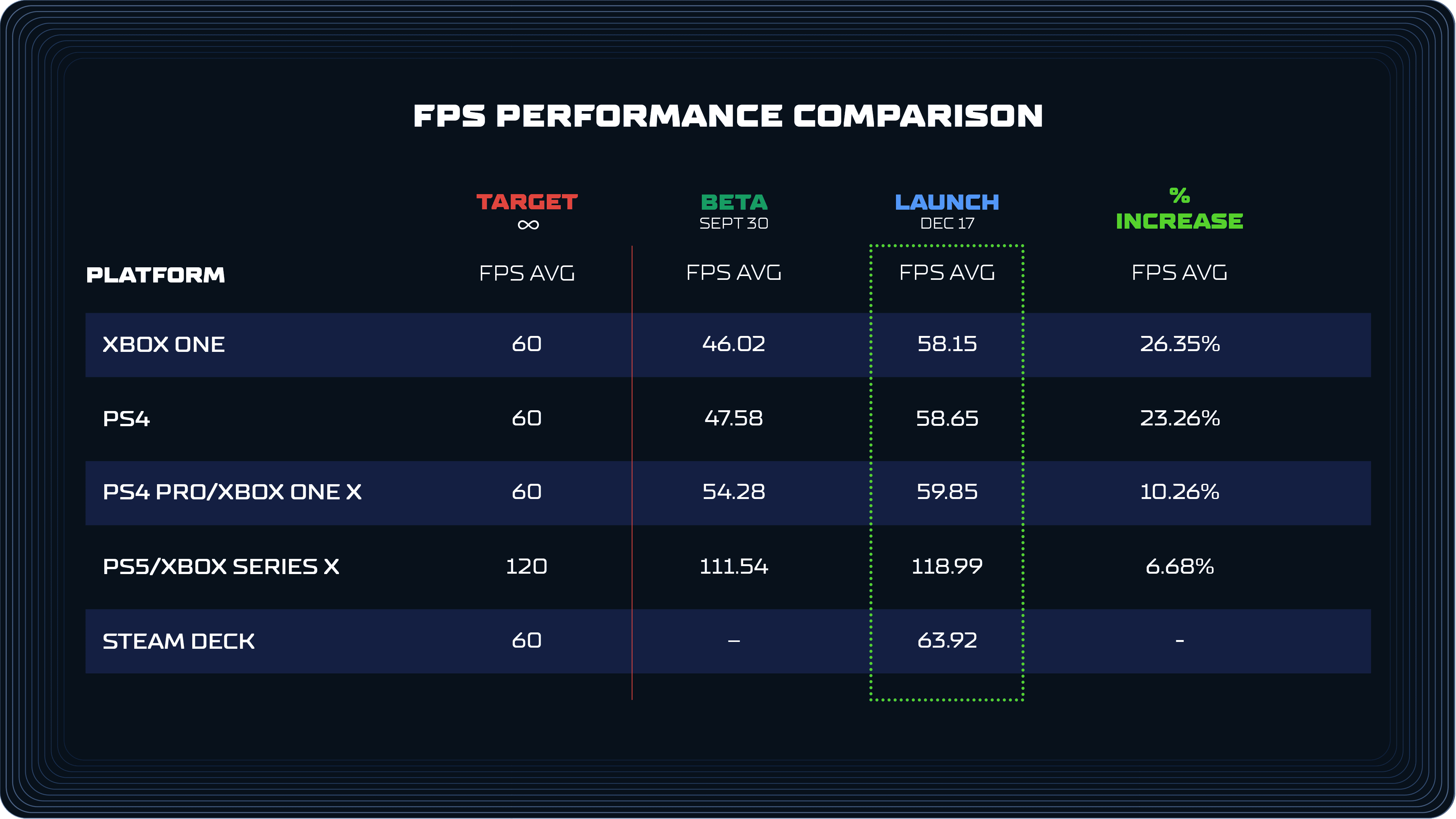
PC saw major gains as well, though it’s harder to represent cleanly due to the wide range of hardware configurations. If you’re playing on PC, let us know what improvements you’re seeing.
Engine and Rendering Improvements
Wojciech: As we mentioned at the top, performance problems, and performance gains, are the sum of many, many smaller pieces. There has been a massive team effort to ensure that we are optimizing the game across all of its many surfaces. Here are a number of deeper optimizations and platform improvements we’ve made:
- We optimized the mesh data format to use about 20% less memory, which reduces VRAM pressure and helps assets stream in faster and more consistently.
- We optimized how water surfaces and the sky atmosphere render, which lowers GPU cost in scenes where those effects are visible for large portions of the match.
- We improved the occlusion query system so the game can more efficiently skip rendering things you cannot see, which helps unlock higher framerates in complex arenas.
- We tuned and optimized Virtual Texturing to smooth out render and streaming time, which reduces texture-related hitches as you move through a map.
- We added a 30 FPS lock when the game is unfocused on PC, which cuts unnecessary GPU load and saves power when you are tabbed out.
- We made targeted platform improvements to increase visual quality on PS4 Pro and Xbox One X without compromising performance.
- We now track performance more closely than ever across builds, including frame time consistency and hitch detection. On PC, you will be able to see some of these additional performance stats by enabling them in settings.
There is so much more to cover, but in the interest of keeping this rundown short, we’ll leave it there. We hope this gives you a small look into the work we have put into ensuring your experience at launch is smooth.
Looking Ahead
All of these changes make a huge difference in how the game feels. Movement stays responsive. Portal fights stay readable. Matches stay smooth even when everything is happening at once.
The truth is, performance work never really ends, but we feel great about where Arena Reloaded is landing. This launch build is the strongest foundation Splitgate has had, and it puts us in a position to keep improving as we add new content and updates.
We cannot wait for you to jump in on the 17th and feel the difference.
See you in the arena tomorrow!
– The Team at 1047

SHARE

